
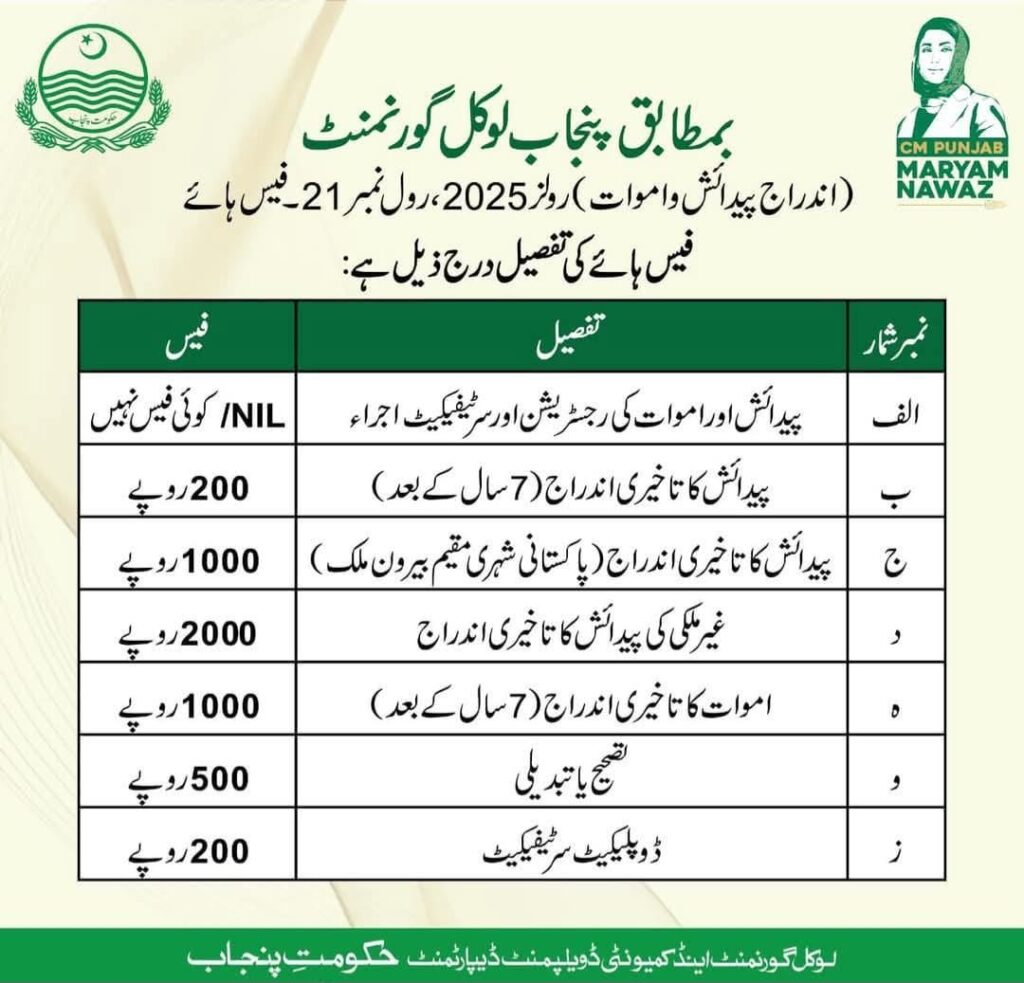
The government of Punjab has waived the computer certificate fee for births and deaths.Govt of punjab
Here is a breakdown of the key fees and procedures:
1. Standard Registration Fees (Within 21 Days)
For both births and deaths, if the event is registered within 21 days, it is typically free of charge. This is to encourage timely registration.
2. Late Registration Fees
If the registration is done after the 21-day window, fees apply. The exact amount can vary slightly depending on the specific municipal corporation or gram panchayat, but the structure is generally as follows:
- After 21 days but within 30 days: A small late fee is levied (often around Rs100 – Rs200, plus any potential small processing charges).
- After 30 days but within one year: Requires a written permission from the prescribed authority (like the District Registrar) and a higher fee (can be around Rs 50 – Rs100).
- After one year: This is considered a “Delayed Registration” and is a more complex process. It requires an order from a Magistrate or a prescribed officer and involves a significantly higher fee, often several hundred rupees.
3. Fee for a Certificate Copy
There is a standard fee for obtaining a certified copy (extract) of the birth or death certificate:
- Standard Fee for a Certificate: This is usually a nominal fee, most commonly RS 250. This fee is for the physical copy of the certificate itself.
How to Register and Pay Fees
The Punjab government has made the process accessible through multiple channels:
- Online (Punjab Sewa Portal):
- The primary portal is www.sewa.punjab.gov.in.
- You can apply for birth/death registration, pay the requisite fees online (via net banking, debit/credit card, etc.), and even download a digitally signed certificate in some cases.
- Offline (In-Person):
- You can visit the concerned Municipal Corporation office (in cities like Ludhiana, Amritsar, Jalandhar, etc.), Municipal Council, or Gram Panchayat Sewa Kendra (in villages) where the birth or death occurred.
- Fees can be paid in cash or sometimes via other modes at the office counter.
Important Documents Required (General List)
- For Birth Registration: Hospital slip/letter, proof of birth, parents’ identity proof (Aadhaar, Voter ID), address proof, and an affidavit in case of delayed registration.
- For Death Registration: Medical certificate stating the cause of death (issued by a doctor/hospital), proof of death, deceased’s identity proof (Aadhaar, Voter ID), and address proof.
Key Takeaway
- Timely Registration (within 21 days): Free
- Delayed Registration: Fees apply (increasing with the delay)
- Copy of Certificate: Approx. Rs 250
For the most accurate and up-to-date fee structure for your specific location and case, it is always best to:
- Check the official Punjab Sewa Portal (www.sewa.punjab.gov.in).
- Contact your local Municipal Corporation office or Union Council Office.
I hope this information is helpful! Is there a specific aspect of the process you’d like to know more about?
The Union Council (UC) is the smallest administrative unit in the local government system of Punjab. It’s the grassroots level of governance, crucial for local development and civic services.
Here is a detailed breakdown:
1. What is a Union Council?
A Union Council is an administrative subdivision of a Tehsil (or Town) within a District. A typical district is made up of several tehsils, and each tehsil is further divided into numerous Union Councils.
2. Structure of a Union Council in Punjab
Each Union Council is governed by an elected body. The key positions are:
- Chairman: The elected head of the Union Council.
- Vice Chairman: The deputy to the Chairman.
- General Councillors: Several directly elected members.
- Reserved Seats: Councillors elected on reserved seats for Peasants/Workers, Women, and Youth.
This council is responsible for local civic matters and development projects within its jurisdiction.
3. How to Find Details for a Specific Union Council
Since Punjab has 36 districts, each with multiple tehsils and hundreds of Union Councils, I cannot list them all here. However, I can guide you to the official sources where you can find the exact details you need.
Best Official Source: The Punjab Local Government Department
The most accurate and up-to-date information is available on the official government portal.
- Punjab Local Government Department Website: You can visit their official site. They often have directories or lists of union councils by district.
- Website:
lgd.punjab.gov.pk(Please note: Government website structures can change, but this is the primary source).
- Website:
- Punjab Portal (One-Stop Shop): The main government portal for Punjab also provides access to this data.
- Website:
www.punjab.gov.pk
- Website:
How to Search on These Portals:
- Look for sections titled “Local Government,” “Administrative Units,” “District Profiles,” or “Union Councils.”
- You will typically need to drill down by selecting your District first, then your Tehsil, and finally you will see a list of all Union Councils in that tehsil.
4. Alternative Source: The Election Commission of Pakistan (ECP)
For electoral purposes, including constituency delimitation (which defines UC boundaries), the ECP website is an excellent resource. It provides maps and detailed lists of all union councils.
- Website:
www.ecp.gov.pk
How I Can Help You Further:
If you are looking for information for a specific district or tehsil, please provide the name, and I can do my best to guide you more precisely or find a direct link if available.
For example, you could ask:
- “List of Union Councils in Tehsil Faisalabad City”
- “How many Union Councils are in District Lahore?”
- “Who is the Chairman of Union Council [UC Name] in [Tehsil Name]?”
Major Metropolitan Cities (Largest by Population & Economic Importance)
These are the largest and most well-known cities, often referred to as the “big five.”
- Lahore – The capital City of Punjab and second-bigger city in Pakistan. It is the cultural, historical, and educational hub, known as the “Heart of Pakistan.”
- Faisalabad – The third-largest city in Pakistan and a major industrial and textile center, often called the “Manchester of Pakistan.”
- Rawalpindi – A key military and commercial center, adjacent to the national capital, Islamabad. They form a large metropolitan area together.
- Gujranwala – Another major industrial city, famous for its electrical goods, ceramics, and sports industry.
- Multan – One of the oldest city of Punjab. Known as the “City of Saints” due to its numerous Sufi shrines and a major center for agriculture (especially mangoes).
Other Major District Headquarters and Cities
These are important cities that serve as the administrative centers of their districts.
- Sialkot – A global export hub renowned for its sports goods (e.g., footballs), surgical instruments, and leather products.
- Bahawalpur – A historically princely state, known for its palaces like Noor Mahal and proximity to the Cholistan Desert.
- Sargodha – A major district known as the “City of Eagles,” with a large Pakistan Air Force base and a significant citrus fruit (kinnow) industry.
- Jhang – A agricultural city on the banks of the River Chenab.
- Dera Ghazi Khan (DG Khan) – A key city in South Punjab, serving as a gateway to Balochistan province.
- Sahiwal – An important agricultural and industrial city, formerly known as Montgomery.
- Okara – Another significant agricultural city with large farms and milk production.
- Rahim Yar Khan – A major city in South Punjab, known for its sugar mills and the famous Sheikh Zayed Mosque.
- Kasur – Located near the border with India, famous for its Sufi poet Bulleh Shah and a historic city.
- Sheikhupura – An industrial city, and home to the historical Hiran Minar.
Other Notable Cities and Towns
- Jhelum – A city on the banks of the Jhelum River, known for its military history and as a gateway to the picturesque Punjab countryside.
- Gujrat – Famous for its ceramic, pottery, and furniture industries.
- Mianwali – Known for its proximity to the Kalabagh Dam site and as the hometown of Imran Khan, former Prime Minister of Pakistan.
- Hafizabad – Known for its rice production.
- Mandi Bahauddin – An agricultural city known for its grain market.
- Pakpattan – A historically and religiously significant city, home to the shrine of Sufi saint Baba Farid.
- Vehari – A major cotton-producing city.
- Nankana Sahib – The birthplace of Guru Nanak, the founder of Sikhism, and a key pilgrimage site.
- Attock – Strategically located at the intersection of Punjab, Khyber Pakhtunkhwa, and Islamabad.
- Lodhran – An important railway junction city.
This list covers the most prominent cities, but Punjab has many more towns and smaller cities, each with its own unique character and importance.
Punjab government:
In a significant move toward digital empowerment and administrative ease. The Punjab government has announced the waiver of fees for computer-generated certificates for births and deaths.
This progressive decision is not just a relief for citizens. Its a bold step toward modernizing public services and ensuring accessibility for all.
For years, obtaining official documents like birth and death certificates often involved cumbersome processes, delays, and out-of-pocket expenses that burdened families, especially those from economically weaker sections. The introduction of computer-generated certificates was already a leap forward in reducing manual errors and improving efficiency. Now, by eliminating the fee entirely, the government has removed a financial barrier, making these essential documents free and easily accessible to every resident of Punjab.
This initiative reflects a broader commitment to leveraging technology for public welfare. It aligns with the state’s vision of a digitized, transparent, and citizen-friendly administration. Whether it’s for school admissions, legal purposes, or claiming insurance, birth and death certificates are fundamental records. Making them free ensures that no one deprives these services of cost constraints.
Moreover, this move is expected to prompt more people to register births and deaths promptly, improving the accuracy of vital statistics—a crucial element for effective governance and planning..
The Punjab government’s decision sets a commendable example for other states to follow. It’s a small change with a big impact: simplifying lives, promoting inclusivity, and reaffirming that good governance is about putting people first
Read more: The Punjab government fee for births and deaths.Contact Us:Home